Refrigerator Repair
Viking Fridge Warm, Freezer Cold: Read the Airflow First
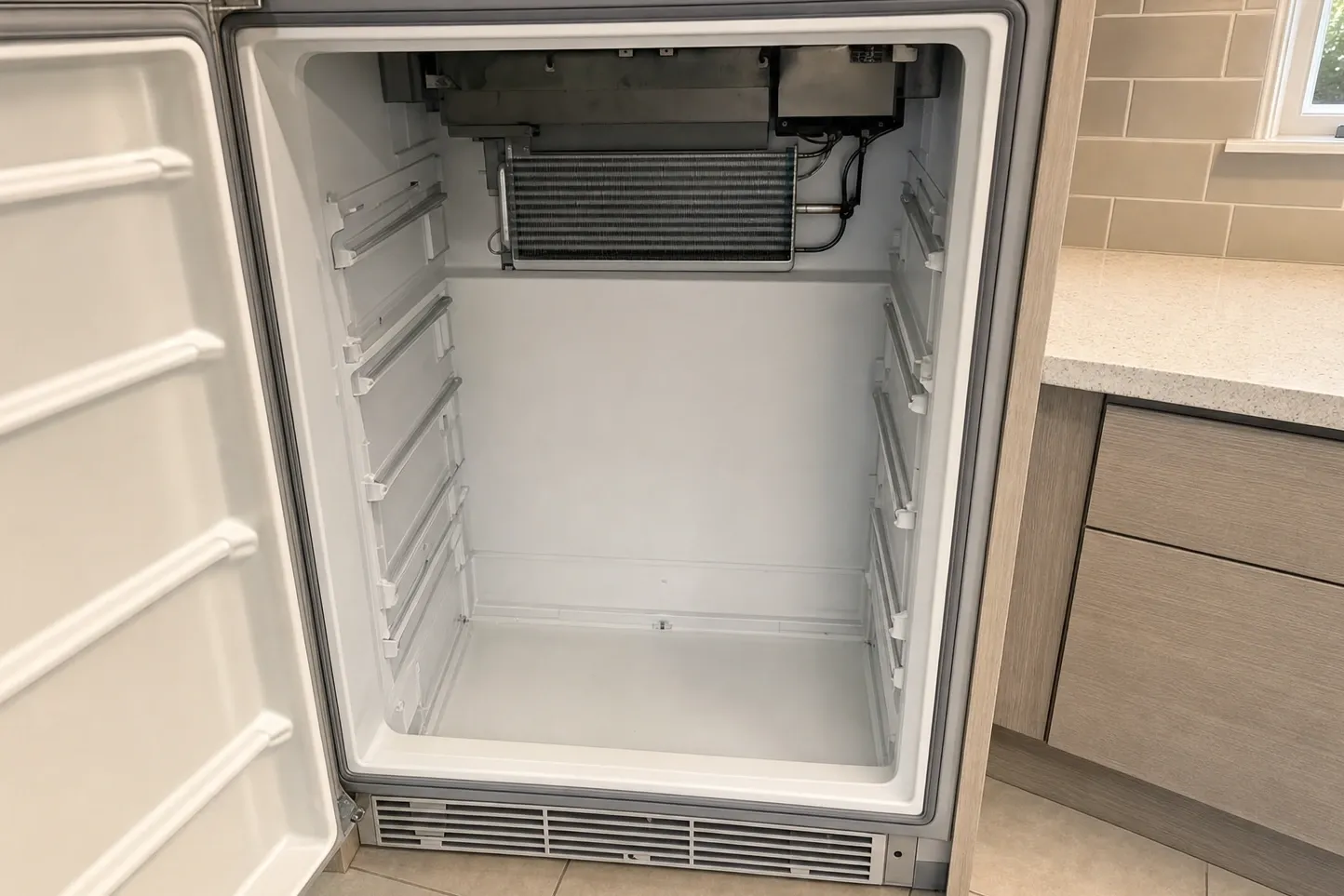
A Viking built-in that keeps the freezer hard while the fresh-food compartment drifts into the fifties looks alarming and usually is not. In almost every case the refrigerant is fine and the compressor is running. What has stopped is the movement of cold air from one compartment to the other.
What the split is telling you
Most built-in refrigeration makes cold in one place and distributes it. There is an evaporator behind a panel, a fan that pushes air across it, and ducting that carries that air where it is needed. If the freezer is at temperature, the sealed system is doing its job. If the fridge is not, the cold is being made and not delivered.
That single observation eliminates most of the expensive possibilities before anyone opens a toolbag, and it is why the milk turning early while the ice cream stays solid is genuinely good news.
The four usual causes, in order
1. Evaporator iced over. The fan sits behind the rear panel of the freezer, inside a fin pack. When ice bridges those fins the fan either stalls or simply pushes air through a block of ice. A fan that is running but sounds harsher than usual — a chirp, a rattle, a whirr that changes pitch when the door opens — is often clipping ice.
2. A blocked defrost drain. The evaporator is supposed to shed its frost on a cycle, and that water is supposed to leave down a drain at the base of the fin pack. When the drain plugs, the water refreezes where it sits and builds upward into the fins. This is the most common single fault behind the first one, and it is why clearing ice without clearing the drain buys a few weeks and no more.
3. A defrost circuit that has stopped defrosting. A failed heater, a sacrificial thermal fuse that has done its job, or a control that no longer calls for defrost all produce the same slow slide: fine for weeks, gradually warmer, worse after a hot day of door openings.
4. A door that no longer seals. A gasket that has gone hard, or a door pulled slightly out of alignment, lets warm humid room air in continuously. The unit never catches up, and all that moisture goes to the evaporator as frost. On panel-ready units a heavy custom door panel can drag the top hinge over time, which is a mechanical fix and not a refrigeration one.
What you can check safely in ten minutes
- Put a thermometer in a glass of water in the middle of the fridge and read it after four hours. Compare that with the display. A display that disagrees with reality by several degrees is a sensor conversation, not an airflow one.
- Find the vents inside the fresh-food compartment and make sure nothing is parked against them. A wide platter across a rear vent will do this on its own.
- Listen at the freezer with the door open and the switch defeated if your model allows it. You should hear a fan. Silence, or a fan that starts and stops, is a strong clue.
- Look at the rear freezer panel for frost creeping out around its edges, and at the floor of the freezer for a sheet of ice. Both point at the drain.
- Check the gasket by trapping a strip of paper in the shut door and tugging it back out. You want resistance at every point you try. Wherever it comes away clean, warm air is getting in there too.
- Pull the lower grille and look at the condenser — see the next section.
None of that requires a panel to come off, and all of it narrows the diagnosis considerably before a visit.
Why a Los Angeles summer changes the odds
Heat does not usually cause a warm-fridge-cold-freezer split by itself, but it sets the table for it. In Woodland Hills and the west Valley a condenser coil behind the toe-kick grille runs through afternoons in the high nineties and above, and it collects dust and pet hair as it does. A matted coil makes the compressor run longer for the same result, longer run times mean more frost at the evaporator, and more frost means the defrost cycle has more to clear than it was designed for. The unit that finally shows a warm fresh-food side in July has often been running on the edge since May.
Coastal kitchens in Venice get a different version of the same story: less heat, more humidity, and a gasket that hardens faster in salt air. The result at the evaporator is identical.
Pulling the lower grille and vacuuming the condenser twice a summer is the single most useful thing an owner can do for a built-in in this metro.
When it really is the sealed system
There are calls where it is. A compressor that runs continuously with barely cool air anywhere, a suction line that is not cold, a temperature split that will not open up after a full defrost, oil staining at a joint — those are gauge findings, and they are the end of a diagnosis rather than the start of one.
The honest order is: prove the air is moving, prove the defrost is working, prove the door is sealing, then talk about refrigerant. Anyone who reaches for gauges before checking a drain is guessing, and on a built-in that guess is expensive.
If the fridge is warm now and there is food in it, move what matters to the freezer or a cooler, leave the doors closed, and get it looked at. A drain and a gasket are small jobs. A compartment full of spoiled food is not.
Follow-ups
Should I turn the fridge colder to compensate?
It rarely helps and often makes it worse. If the fresh-food side is warm because cold air is not reaching it, a colder setpoint just runs the compressor longer and grows more ice at the evaporator. Leave the setting where it is and find out why the air has stopped moving.
How long should a manual defrost take to prove the point?
Empty the compartment, switch the unit off at the panel and leave the doors open for a full day, longer for a heavy build-up. If it works normally for two or three days afterwards and then drifts warm again, the defrost circuit is the fault and the ice was only the symptom.
Is a warm fridge with a cold freezer ever a sealed-system fault?
It can be, but it is the last conclusion rather than the first. A genuine refrigerant or compressor fault usually takes the freezer with it, and it shows up on gauges and in the temperature split. Airflow and defrost faults account for most of these calls.