Oven Repair
Why did the broiler quit while bake still works?
An oven that does nothing at all could be almost anything. An oven where one half works and the other does not has already done most of the thinking for you, because everything the two halves have in common is demonstrably alive: the supply reaching the appliance, the door switch, the clock, and most of what the control does.
So the question is never really “why has the broiler stopped”. It is “what does broiling use that baking does not”, and on most ovens that list is short enough to get through in one visit.
What you can see from the doorway, cold
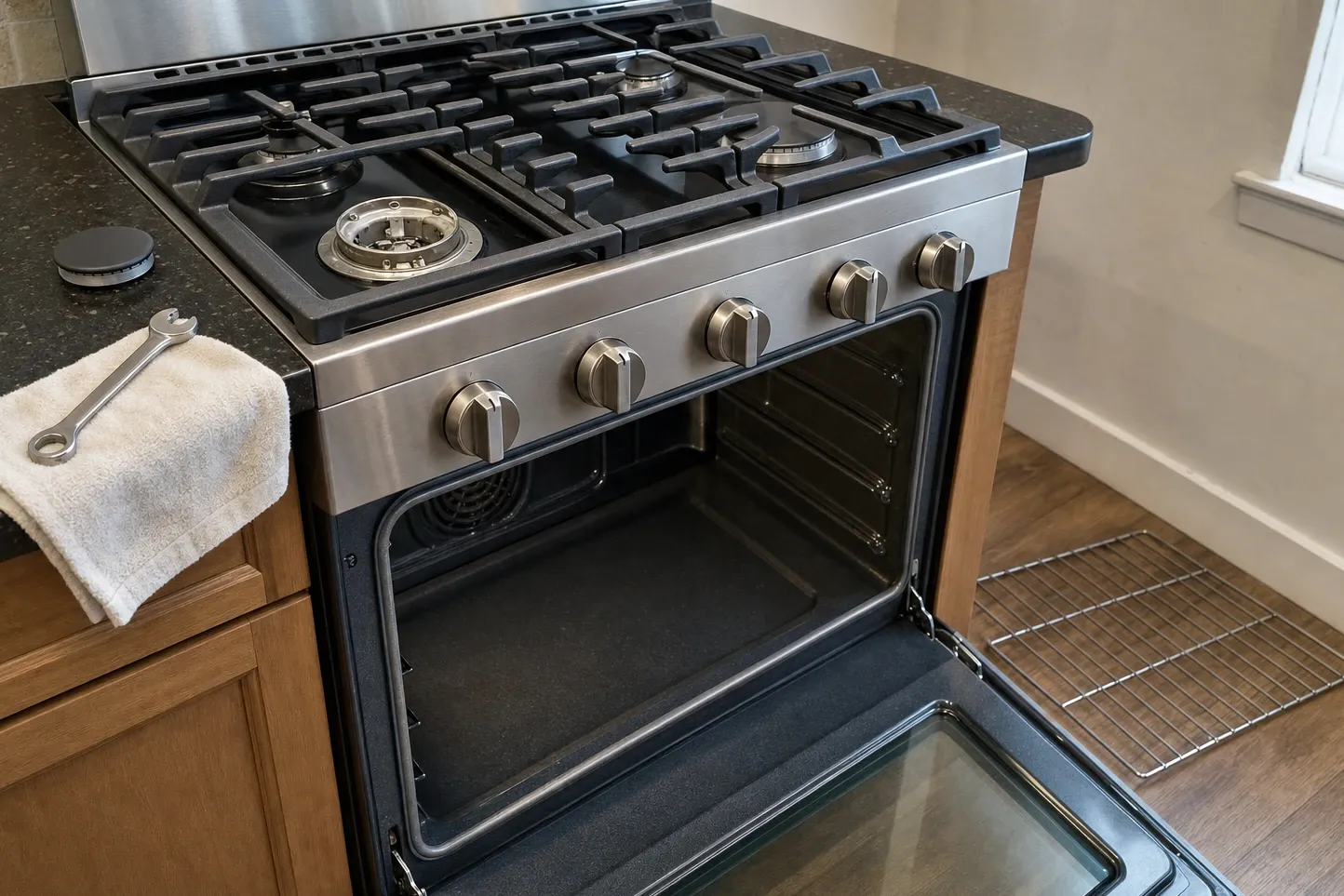
With the oven off and cold, open the door and look up at the roof of the cavity. On an electric oven that is where the broil element runs. Look; do not touch, do not press it, and do not poke at anything behind it.
What you are hoping to find is obvious damage: a blistered patch, a split, a section that has sagged out of line with the rest, or a bright scorch mark on the metal near it. Any of those is your answer and worth mentioning on the phone.
What you will usually find is an element that looks brand new. That is the awkward truth of this fault. The break is inside the sheath, where the circuit runs, and it leaves no mark at all on the outside. Plenty of people talk themselves out of the right answer at this point because the part looks too healthy to be the culprit.
If you want one more clue, set the oven to broil for a minute and watch from the front of the kitchen rather than from close up, with nothing in the cavity. An element that never colors anywhere, or one that colors at one end and stays dark at the other, is a useful thing to be able to report. Then switch it off.
Element, relay or control: what separates them
Four things can produce exactly what you are looking at, and they fail at quite different rates.
The element itself is the first and the commonest. Heating elements age by being heated, and a broil element does its work in short, savage bursts, which is harder on it than the long steady run baking asks for.
The connections behind it are second. An element is joined to the oven’s wiring at terminals that spend their lives hot, and hot connections loosen, discolour and eventually stop conducting. Near the water, in Venice and Marina del Rey, they also corrode, and this site has a whole article about what that air does to exposed metal in a kitchen.
Third is the switching. On most electric ovens each heating function is turned on by its own switch inside the control, so one that no longer closes leaves a perfectly good element sitting there cold while everything else behaves normally. That is precisely the fault you have, which is why the switching is on the list even when nothing else points at it.
Fourth, and last for a reason, is the control itself: a mode that has been left set, a key that the panel thinks is being held down, or a fault the oven has recorded and is not showing you. It happens, and it is worth ruling out, but jumping to it first is how people end up paying for the wrong part.
Gas ovens, where the same complaint means something else
If your oven is gas, throw most of the above away. Depending on the model, broiling may come from a separate burner at the top of the cavity with its own ignition, or from the same burner that bakes, run in a different pattern. Where there is a burner of its own, the reason it stops is more often the ignition than the burner.
Either way, there is nothing here for an owner to do. Do not look for a pilot, do not open anything, and do not try broiling repeatedly to see if it catches. If you can smell gas at any point, leave the kitchen, do not touch switches, and call your gas utility from outside — and 911 if the smell is strong.
What the visit measures
A technician settles this in an order, and the order is the point. First the element gets a meter across it with the power off, which either finds the break or clears the part in about a minute. If the element reads healthy, the terminals and the wiring to it get looked at, because a scorched connection is both the second most likely cause and the one that gets missed. If both are sound, attention moves to the switching, and only then to the control board.
That sequence is what the $89 visit is for: it ends with a named part rather than a guess, and it comes off the repair when you go ahead. Viking Repair Pros of Los Angeles takes those calls on (213) 652-7030, and the more of the above you can already answer, the shorter the visit is.
Follow-ups
Can I keep baking while the broiler is out?
In most cases yes, provided the oven heats normally, holds its setting and nothing smells hot or electrical. If the breaker has tripped even once, or if you can smell anything burning that is not food, stop using it and have it looked at before the next meal.
The element looks perfect. Doesn't that rule it out?
No, and this is the part that surprises people most. Elements fail electrically far more often than they fail visibly, so the metal can look untouched while the circuit inside it is broken. A blister or a split is proof of a failure; smooth metal proves nothing either way.
Will you know which it is before you arrive?
Not for certain, but the phone call narrows it a long way. Tell Viking Repair Pros of Los Angeles on (213) 652-7030 whether bake still heats, whether the broiler ever glows, and whether anything changed on the day it stopped. Those three answers decide which parts are worth bringing.
Part before
This is where the series starts